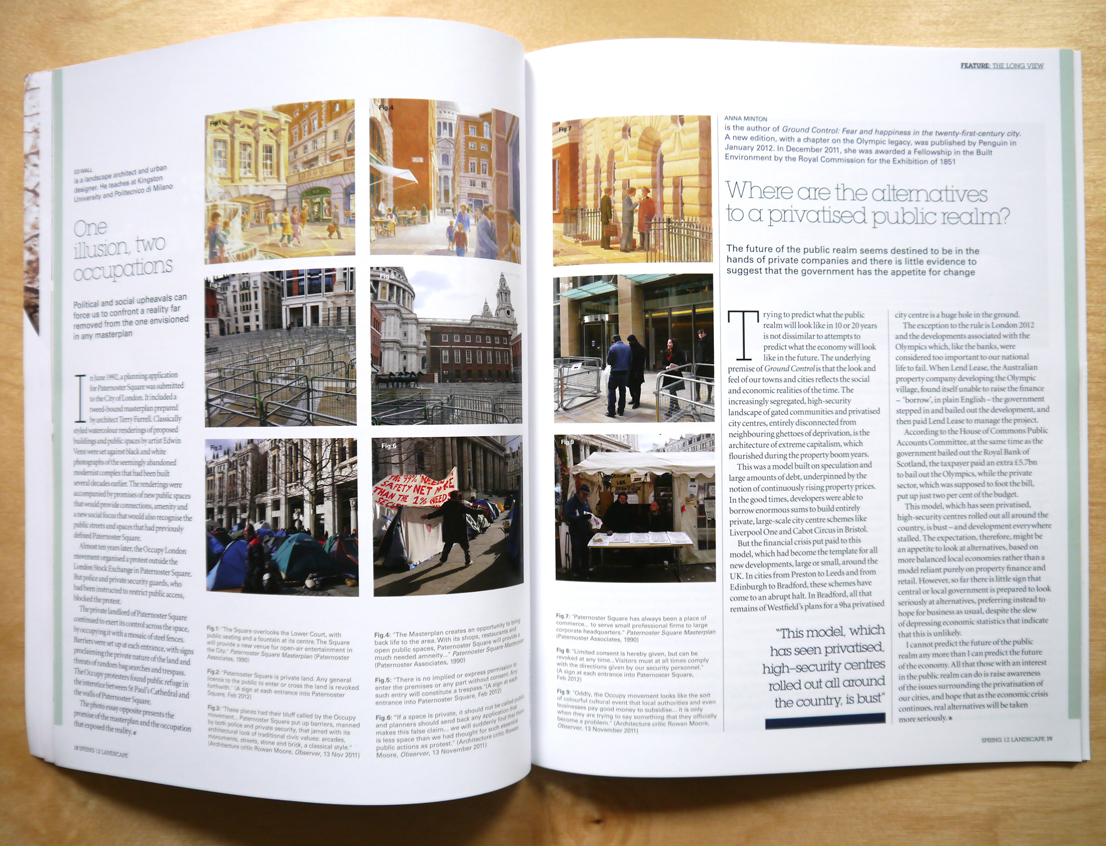
ONE ILLUSION / TWO OCCUPATIONS
The Spring edition of Landscape, The Journal of the Landscape Institute, featured ten short essays on the near future of landscape. It was introduced by a quote from William Gibson, “The future’s already here: it’s just not evenly distributed”, and it featured a photo essay by Ed that illustrated the contrast between the planning, occupation and control of Paternoster Square in London. Authors of other articles included: Anna Minton, Ian Thompson, Ruth Olden, Eleanor Lawrence, Paul Campbell, Jon Hazlewood, Simon Bell, Paul Reynolds and Rob Holmes.
The photos essay was introduced with the following text:
In June 1992 a planning application for Paternoster Square was submitted to the City of London. It included a tweed-bound masterplan filled with classically styled water colour renderings. These images of proposed buildings and public spaces were set against black and white photographs of the seemingly abandoned modernist complex that had been completed several decades earlier. The renderings were accompanied by promises of new public spaces that would provide connections, amenity and a new social focus and that would also recognise the public streets and spaces that had previously defined Paternoster Square.
Almost ten years later the Occupy London movement organised to protest outside of the London Stock Exchange in Paternoster Square. The protest was blocked by police and private security guards who had been instructed to restrict access to the square. The private landlord of Paternoster Square continued to exert its control by occupying the space with a mosaic of steel fences. Barriers were set up at each entrance with signs proclaiming the private nature of the land and threats of random bag searches and trespass. The Occupy protesters found public refuge in the interstice between St Pauls Cathedral and the walls of Paternoster Square.
This photo essay presents the promise of the masterplan and the occupations that exposed the reality.
Fig 1: “The Square overlooks the Lower Court, with public seating and a fountain at its centre. The Square will provide a new venue for open-air entertainment in the City.” Paternoster Square Masterplan (Paternoster Associates 1990)
Fig 2: “Paternoster Square is private land. Any general licence to the public to enter or cross the land is revoked forthwith.” (Sign at each entrance into Paternoster Square, February 2012)
Fig 3: “These places had their bluff called by the Occupy movement… Paternoster Square put up barriers, manned by both police and private security, that jarred with its architectural look of traditional civic values: arcades, monuments, streets, stone and brick, a classical style.” (Architecture critic Rowan Moore, Observer, 13 November 11)
Fig 4: “The Masterplan creates an opportunity to bring back life to the area. With its shops, restaurants and open public spaces, Paternoster Square will provide a much needed amenity…” Paternoster Square Masterplan (Paternoster Associates 1990)
Fig 5: “There is no implied or express permission to enter the premises or any part without consent. Any such entry will constitute a trespass.” (Sign at each entrance into Paternoster Square, February 2012)
Fig 6: “If a space is private, it should not be called public, and planners should send back any application that makes this false claim… we will suddenly find that there is less space than we had thought for such essential public actions as protest.” (Architecture critic Rowan Moore, Observer, 13 November 11)
Fig 7: “Paternoster Square has always been a place of commerce… to serve small professional firms to large corporate headquarters.” Paternoster Square Masterplan (Paternoster Associates 1990)
Fig 8: “Limited consent is hereby given, but can be revoked at any time… Visitors must at all times comply with the directions given by our security personnel” (Sign at each entrance into Paternoster Square, February 2012)
Fig 9: “Oddly, the Occupy movement looks like the sort of colourful cultural event that local authorities and even businesses pay good money to subsidise… it is only when they are trying to say something that they officially become a problem.” (Architecture critic Rowan Moore, Observer, 13 November 11)
[Renderings from the Paternoster Square Masterplan by Edwin Venn; photos by Ed Wall; quotes from Paternoster Square Masterplan, Architecture critic Rowan Moore, and signs by Paternoster Square management outside of Paternoster Square after the attempted Occupy protest; article edited by George Bull]